
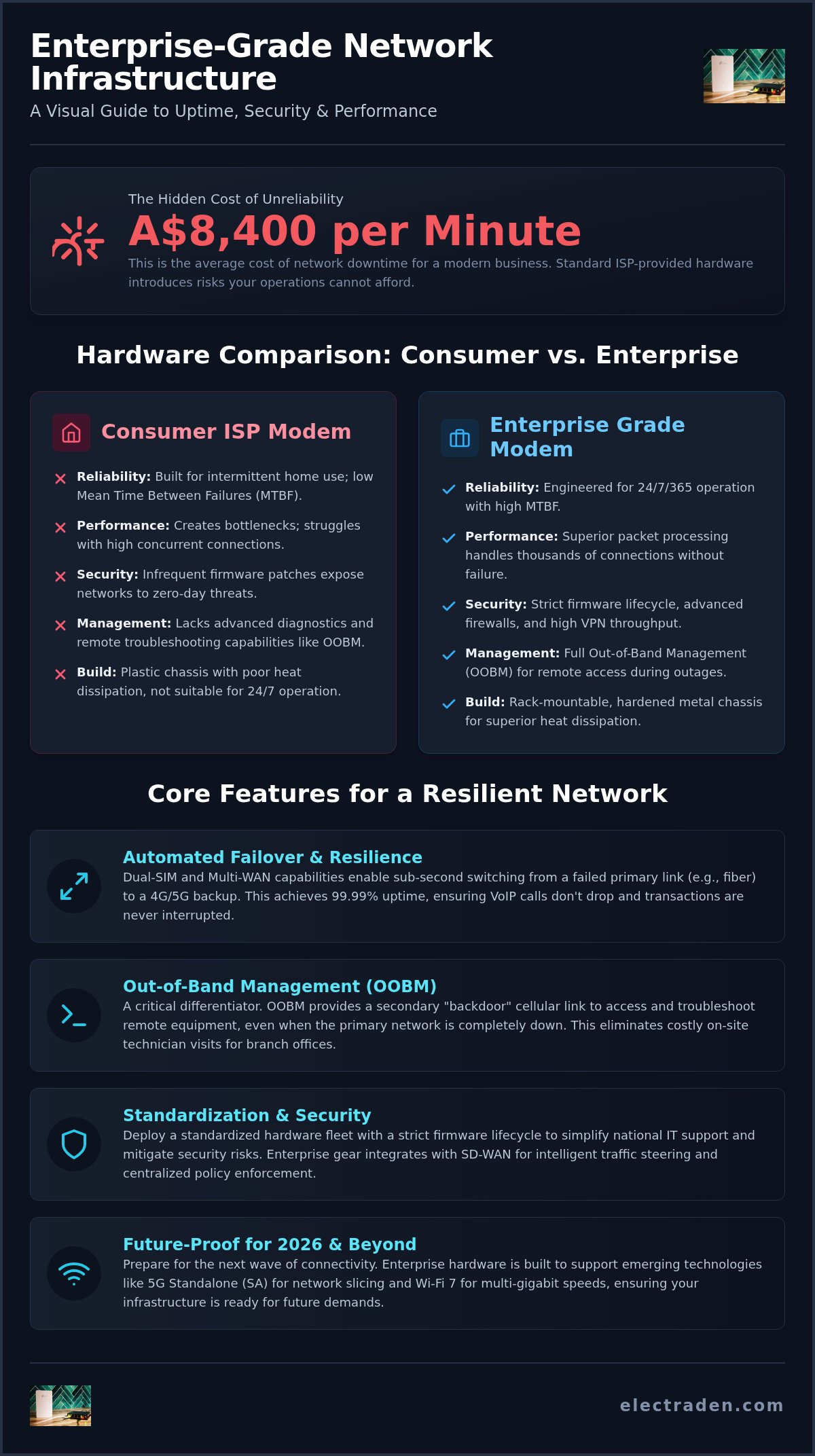
The average cost of network downtime for a modern business has climbed to over A$8,400 per minute. You already know that relying on standard ISP-provided hardware is a gamble your bottom line can't afford, especially when peak hour congestion or hardware failures threaten your operations. Security vulnerabilities in consumer-grade gear often leave remote sites and branch offices exposed to risks that professional environments simply can't tolerate. Transitioning to enterprise grade modems isn't just about increasing bandwidth; it's about building a resilient, programmable foundation for your entire business infrastructure.
We'll help you master the technical requirements and selection criteria for high-performance hardware to ensure 100% uptime. You'll learn how to achieve 99.99% reliability with advanced failover solutions and centralise network management across all your Australian locations. This guide previews the shift to Wi-Fi 7 and 5G Standalone architecture, providing the insights needed to future-proof your connectivity for 2026 and beyond. By the end of this article, you'll have a clear roadmap for selecting equipment that eliminates bottlenecks and secures your professional network against the challenges of a data-heavy landscape.
Key Takeaways
- Understand why Mean Time Between Failures (MTBF) and robust build quality differentiate enterprise grade modems from consumer hardware in high-demand environments.
- Implement Dual-SIM and Multi-WAN capabilities to create redundant failover paths that protect your business against primary link failures.
- Utilise Out-of-Band Management (OOBM) to troubleshoot remote branch offices without the need for expensive on-site technician visits.
- Standardise your hardware fleet and establish a strict firmware lifecycle to mitigate zero-day threats and simplify national IT support.
- Leverage volume-based procurement and dedicated business support to streamline the deployment of professional networking infrastructure across multiple sites.
Defining Enterprise Grade Modems in the 2026 Landscape
The modem is the critical bridge between your internal network and the Wide Area Network (WAN). Understanding What is a Modem? involves recognising its role as a modulator-demodulator that translates signals for business use. In a professional environment, this device handles the heavy lifting of signal conversion before passing traffic to high-end routers. By 2026, the shift toward 5G Standalone (SA) and multi-gigabit fiber interfaces has made high-performance hardware essential for Australian businesses looking to maintain a competitive edge.
It's vital to distinguish between standalone modems, gateways, and routers. A standalone modem focuses purely on signal conversion. A gateway combines a modem and router into one chassis, which often sacrifices the granular control IT teams require. Routers handle traffic direction and security, but they rely on the modem's stability to maintain the external link. Using dedicated enterprise grade modems allows for modular upgrades, better thermal management, and improved signal integrity. This modularity ensures that if your connection medium changes, you only replace one component rather than the entire stack.
Enterprise Modems vs. Consumer Hardware
Reliability is measured by Mean Time Between Failures (MTBF). Consumer devices are built for intermittent home use, while enterprise units are designed for 24/7 operation under heavy load. Professional hardware provides superior packet processing power, ensuring that thousands of concurrent connections don't cause the device to hang or reboot. These units often feature industrial-grade components that withstand higher operating temperatures. Enterprise grade modems are hardware components engineered specifically for continuous uptime and sophisticated remote management within complex network architectures.
Why ISP-Provided Modems Are a Business Risk
Standard ISP hardware often creates a bottleneck effect. You might have a high-end Ubiquiti router, but a basic modem will limit its throughput and increase latency. Security is another concern. Consumer firmware receives infrequent patches, leaving your branch offices exposed to zero-day threats. Professional gear offers:
- Advanced logging and diagnostic tools for rapid troubleshooting.
- Hardened chassis for better heat dissipation in server racks.
- Support for 5G network slicing to prioritise critical traffic.
- Integration with Software-Defined Wide Area Networking (SD-WAN) for better traffic steering.
Relying on residential gear puts your data at risk. Most ISP-provided units lack the stateful firewall capabilities or VPN throughput required for modern business operations. Investing in enterprise grade modems ensures that your security posture remains robust from the very edge of your network.
Essential Features of Professional Connectivity Solutions
Professional networking requires more than a stable signal. It demands hardware that manages complex routing and redundant paths with precision. Enterprise grade modems provide Dual-SIM and Multi-WAN capabilities, allowing businesses to maintain connectivity even if a primary carrier experiences an outage. These devices aren't just plastic boxes; they feature rack-mountable metal chassis designed for seamless integration into standard Australian server room environments. This physical durability ensures long-term reliability in 24/7 operating conditions.
Out-of-Band Management (OOBM) is a critical differentiator that sets professional gear apart. It allows IT teams to access the modem's console via a secondary cellular link even when the primary fixed-line network is down. This feature eliminates the need for expensive technician site visits to remote branch offices. For businesses managing dozens of locations nationally, OOBM significantly reduces operational costs and Mean Time to Repair (MTTR). It provides a backdoor for troubleshooting that consumer hardware simply doesn't offer.
Automated Failover and Network Resilience
Downtime is expensive. With the average cost of network failure impacting revenue every second, achieving 99.9% uptime is a baseline requirement for modern infrastructure. Enterprise modems achieve this through sub-second switching between primary fiber and backup 4G/5G LTE links. This seamless transition ensures that voice-over-IP (VoIP) calls don't drop and transaction processing remains uninterrupted. If you're looking to upgrade your resilience, explore our range of professional networking hardware.
Security and Firmware Integrity
Security at the edge is paramount. These modems feature hardened operating systems designed to resist brute-force attacks and exploit attempts. They incorporate Stateful Packet Inspection (SPI) and hardware-accelerated encryption for VPN passthrough, ensuring that data remains secure without compromising throughput. Adhering to modern enterprise wireless security standards like WPA3 and implementing Role-Based Access Control (RBAC) ensures that only authorised personnel can modify critical configurations. This prevents unauthorised changes that could lead to security gaps.
Integration with IoT gateways is another essential trend. As smart building management becomes standard, your modem must support the influx of sensor data without overwhelming main traffic lanes. Enterprise grade modems provide the necessary isolation and priority queuing to handle these diverse workloads efficiently. They act as the central anchor for both high-bandwidth office traffic and low-power sensor networks.
Selecting the Right Modem for Your Infrastructure
Choosing the correct hardware involves more than comparing spec sheets. You must evaluate how enterprise grade modems fit into your broader enterprise network infrastructure to avoid creating performance gaps. Start by assessing your bandwidth requirements for the next three years. Plan for future scale. With the rapid adoption of Wi-Fi 7 and high-resolution video conferencing, a modem that barely meets today's needs will become a liability by 2027. Your selection must bridge the gap between current ISP capabilities and your internal network's potential.
Interface matching is equally vital. If your core switch architecture relies on 10Gbps SFP+ ports, selecting a modem with only RJ45 copper outputs introduces unnecessary latency. Consider your vendor ecosystem. For businesses using Ubiquiti UniFi, choosing compatible modems allows for a "single pane of glass" management experience. This integration simplifies monitoring and reduces the time your IT team spends switching between different dashboards. Environmental factors also dictate your choice. Standard office deployments can use traditional rack-mount units, but industrial sites require ruggedised hardware that can handle dust and vibration. Matching the hardware to the physical environment is a prerequisite for long-term stability.
Modems for Head Offices and Data Centres
Head offices require maximum throughput and hardware-level redundancy. Look for fiber modems that support SFP+ interfaces to handle multi-gigabit backhaul without congestion. These environments benefit from Redundant Power Supply (RPS) support. An RPS ensures the modem stays online even if a primary power brick or internal circuit fails. This level of protection is essential for maintaining complex VLAN structures and ensuring the core of your network remains reachable at all times. High-throughput enterprise grade modems in these settings often serve as the primary gateway for hundreds of concurrent users, making stability the priority.
Edge Connectivity for Branch and Remote Sites
Branch locations often lack the space or cooling of a dedicated data centre. Mobile broadband modems are the preferred choice here, offering rapid deployment without waiting for fixed-line installations. Compact form factors allow these devices to fit into small retail cabinets or satellite office desks. Prioritise units that integrate with centrally managed cloud platforms. This allows your central IT team to push configuration updates and security patches to dozens of Australian sites simultaneously. Using a unified management platform ensures that every remote location adheres to the same security and performance standards as your head office.
Best Practices for Deploying Enterprise Modems
Standardisation is the cornerstone of efficient network management. Deploying identical enterprise grade modems across all branch offices allows for uniform configuration templates. This approach minimises human error and speeds up troubleshooting for your IT department. When every site uses the same hardware, your team only needs to master one interface, which significantly reduces the training burden. It also allows for a "hot swap" inventory strategy where pre-configured units can be shipped to any Australian location for immediate replacement during a hardware failure.
Establish a strict firmware update lifecycle. Security threats in 2026 are increasingly sophisticated, often leveraging automated scripts to find unpatched edge devices. Implement a policy where security patches are tested in a lab environment before being pushed to the wider fleet. For cellular-based backups, strategic placement is vital. Position modems near external windows or use high-gain external antennas to ensure maximum signal penetration. Maintain a comprehensive asset register that tracks serial numbers, installation dates, and warranty status to prevent end-of-life hardware from becoming a weak point in your infrastructure.
Physical Installation and Thermal Management
High-density server racks generate significant heat that can lead to thermal throttling or premature component failure. Ensure at least 1U of spacing or active ventilation around your modems to maintain optimal operating temperatures. Use professional cabling standards like Cat6A or Cat7 for all edge connections to support sustained multi-gigabit throughput without interference. Implementing high-quality surge protection is a non-negotiable requirement for protecting expensive business infrastructure from unpredictable voltage spikes and electrical noise.
Monitoring and Proactive Maintenance
Proactive maintenance prevents costly downtime. Configure Simple Network Management Protocol (SNMP) alerts to notify your IT team of link instability or hardware faults the moment they occur. Cloud-based dashboards provide real-time traffic analysis, helping you identify bandwidth bottlenecks before they impact user productivity. Schedule maintenance windows during low-traffic periods to apply non-disruptive updates. If you're planning a multi-site rollout, procure your networking hardware from a strategic partner capable of national fulfilment and volume-based support.
By following these deployment standards, you ensure that your enterprise grade modems operate at peak efficiency. Consistency in physical installation and software management creates a predictable environment that is easier to secure and maintain. This disciplined approach is what separates a professional network from a basic consumer setup.
Streamlining Your Network Procurement with ElectraDen
Procuring hardware for a national rollout requires a partner that understands the scale of enterprise operations. Standard retail checkouts don't offer the flexibility or support needed for complex infrastructure projects. ElectraDen provides a streamlined path for acquiring enterprise grade modems and associated networking gear. With over 12,000 professional items in stock, we ensure that your procurement process remains efficient and predictable. Our national shipping capability means your hardware arrives when and where it's needed, keeping your deployment timelines on track. This logistics advantage is crucial for time-sensitive projects where every day of delay impacts your operational readiness.
High-performance networking isn't just about the specs on the box; it's about the reliability of the supply chain. We offer volume-based pricing models for enterprise-level orders, allowing you to scale your infrastructure without unnecessary financial friction. Our business-scale hardware deployments are backed by a deep understanding of Australian market conditions and network requirements. We act as a strategic partner, ensuring that your procurement officers have a single, reliable point of contact for all networking needs. This centralisation reduces administrative overhead and ensures consistency across your entire hardware fleet.
Why Business Clients Choose ElectraDen
IT departments and procurement officers value reliability and technical expertise. We specialise in professional-grade technology solutions, including high-performance brands like Ubiquiti. Our team understands the nuances of enterprise grade modems and how they integrate into larger WAN architectures. Instead of dealing with generalist retailers, you gain access to a dedicated partner who speaks your language. We prioritise performance and seamless integration, offering support that goes beyond simple retail transactions. This expertise ensures that the hardware you select today remains viable and secure for years to come.
Next Steps for Your Infrastructure Upgrade
Upgrading your network shouldn't be a logistical burden. We provide specialised support for technical hardware selection, helping you match modem interfaces with your existing switch and router architecture. Whether you're outfitting a single data centre or a hundred remote branch offices, our procurement process is designed for speed and accuracy. You can easily Contact ElectraDen for volume pricing on enterprise modems to begin your custom quote process. Our consultants are ready to assist with the specific requirements of your hardware fleet, ensuring 100% uptime through superior equipment selection. Take the next step in future-proofing your business connectivity by partnering with an authoritative expert in the field.
Securing Your Network for the Multi-Gigabit Era
Building a resilient business infrastructure requires a definitive shift toward specialised solutions that prioritise uptime. You've learned that enterprise grade modems provide the necessary redundancy, security, and remote management capabilities to eliminate the risk of costly network failures. By standardising your hardware fleet and implementing proactive monitoring, you create a predictable environment capable of handling the data demands of 2026. It's no longer just about peak speed; it's about the programmable anchor of your entire network resilience.
Selecting the right partner for your rollout is just as critical as the hardware itself. ElectraDen offers over 12,000 professional networking items in stock, ensuring you have immediate access to the exact specifications your project requires. We provide volume-based pricing for businesses and dedicated professional support to streamline your national deployment. Upgrade your infrastructure with enterprise grade modems from ElectraDen and ensure your remote sites remain connected without compromise. Your connectivity is the backbone of your operations. Invest in the professional standard that keeps your business moving forward.
Frequently Asked Questions
What is the difference between a consumer modem and an enterprise modem?
Enterprise grade modems differ from consumer units in their build quality and session handling capabilities. Consumer hardware often lacks the thermal management needed for 24/7 operation, which leads to frequent reboots under stress. Professional units feature metal chassis and high Mean Time Between Failures (MTBF) ratings to ensure stability. They support thousands of concurrent connections, whereas residential gear often bottlenecks when multiple users access high-bandwidth applications simultaneously. This reliability is vital for maintaining business infrastructure.
Do enterprise grade modems work with all Australian NBN plans?
Professional modems are compatible with Australian NBN plans, provided you match the physical interface to your specific connection type. For Fibre to the Premises (FTTP) or HFC, you require a unit with a high-speed Ethernet WAN port. For Fibre to the Node (FTTN) or Basement (FTTB), you must select hardware that supports VDSL2 standards. Always verify the NBN technology active at your location before procurement to ensure seamless integration with your existing service provider.
Why should I buy a standalone modem instead of a modem-router combo for my business?
Standalone modems offer superior modularity and performance compared to integrated combo units. Separating the modem from the router prevents a single point of failure and allows you to upgrade your routing capabilities without replacing your entire WAN interface. This setup provides better heat dissipation in server racks and ensures your router's processor isn't taxed by signal modulation tasks. It results in a more stable, scalable network architecture that grows with your business requirements.
Can an enterprise modem improve my network security at the edge?
Professional modems significantly enhance security at the network edge through hardened firmware and hardware-level encryption. These devices receive frequent security patches to mitigate zero-day vulnerabilities that consumer-grade hardware often ignores. Features like Role-Based Access Control (RBAC) and stateful firewalls ensure only authorised personnel can modify critical settings. This creates a robust first line of defence against external threats, protecting your branch offices and sensitive internal data from unauthorised access or interception.
What is Out-of-Band Management (OOBM) in enterprise networking?
Out-of-Band Management (OOBM) provides a secondary communication path to your hardware, typically via an integrated cellular modem. This allows IT teams to access the device's console and troubleshoot issues even if the primary fiber link is completely offline. It eliminates the need for expensive technician site visits by enabling remote reboots and configuration changes. OOBM is a standard requirement for managing remote satellite offices and ensuring constant network visibility regardless of primary link status.
How do I choose between a wired and a 5G enterprise modem?
Base your decision on your site's physical infrastructure and specific latency requirements. Wired modems are ideal for permanent locations where high-speed fiber is available and low latency is critical for VoIP or real-time data processing. 5G enterprise modems are better for rapid deployment at temporary sites or as a primary link where fixed-line infrastructure is unreliable. Many Australian businesses now deploy both, using 5G as an automated failover path for maximum network resilience.
Does ElectraDen offer bulk discounts for large office deployments?
ElectraDen provides volume-based pricing models tailored for large-scale office deployments and national rollouts. We maintain over 12,000 items in stock to support bulk orders without the long lead times common in the retail industry. Business clients can request custom quotes for enterprise grade modems to ensure they receive the most competitive rates for their infrastructure projects. Our dedicated support team assists with the procurement process to facilitate efficient and cost-effective hardware acquisition.
Is professional installation required for enterprise grade modems?
While many enterprise grade modems feature intuitive interfaces, professional configuration is recommended for complex environments involving VLANs or SD-WAN integration. ElectraDen specialises in hardware supply and does not provide on-site installation services. You should consult with a qualified network engineer to ensure your equipment is correctly rack-mounted and integrated into your security stack. Correct installation ensures you maximise the performance, security, and longevity of your professional-grade networking equipment in a 24/7 environment.